The towel comes before the blade
A line shaved above the natural hairline grows in crooked a week later. So we read the grain first, and we steam before we sharpen. This is a journal about that order of operations — not a chair you book, but a method you can read.
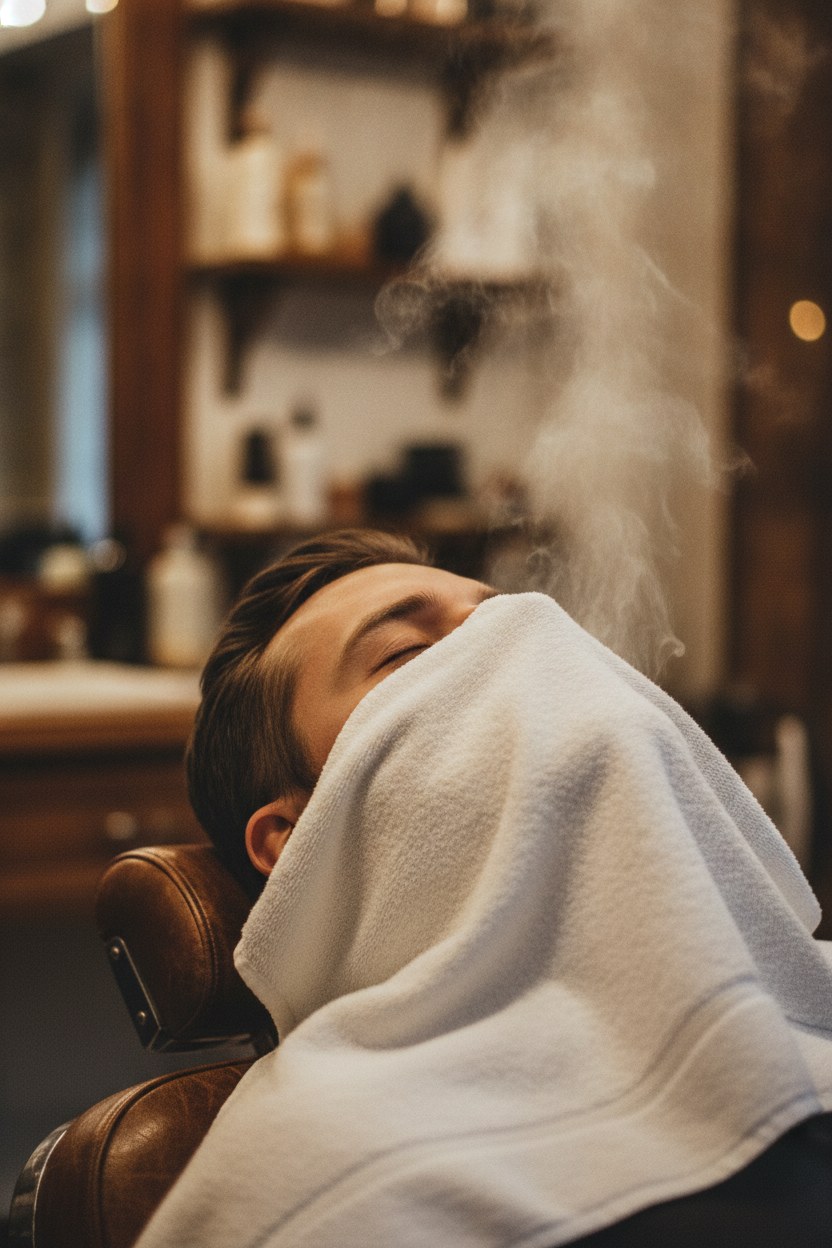 Hot towel · 42 °C
Why a barber warms the cloth before he strops the steel
The first thing a good shave does is nothing. The barber lays a towel, almost too hot to hold, across your jaw and leaves it. For two minutes the room is quiet and the blade stays shut. People read this as theatre. It is not. The towel is doing the only work that cannot be rushed — it is standing the beard up and softening the keratin so that when the edge finally comes it cuts hair and not skin.
Beard hair is roughly as hard as copper wire of the same thickness. Dry, it blunts an edge and drags the follicle. Warm and wet, it swells, softens, and leans away from the skin. A straight razor shaves what it can reach; the towel's whole job is to bring the hair up where the edge can reach it cleanly, in one light pass, in the direction it already wants to lie.
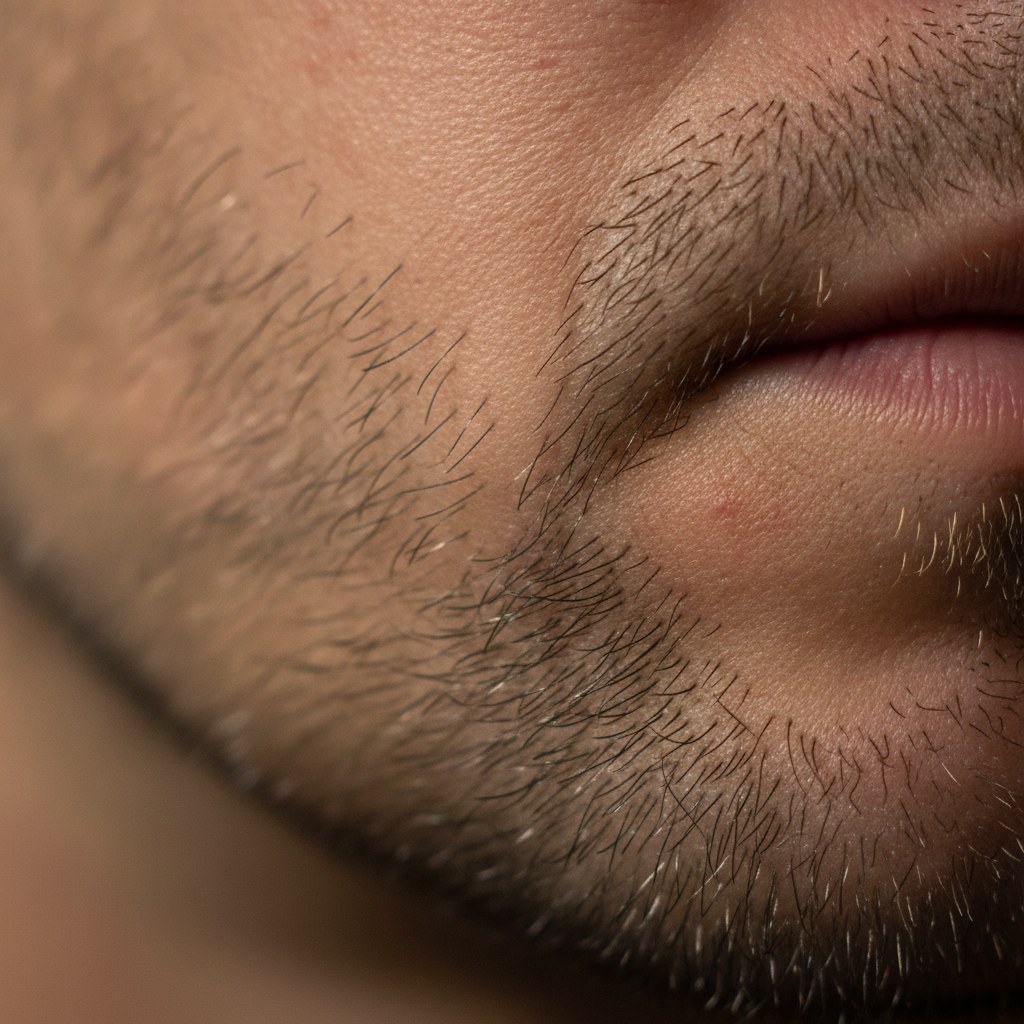
That direction has a name on every face: the grain. It is not one direction. Cheeks usually fall downward and are forgiving. The moustache is coarse and often grows straight down over the lip. The chin is a knot of short, stubborn hair pointing several ways at once. And the neck — the neck is where every shave is won or lost, because below the jaw the grain swirls, reverses, and lies almost flat against the skin.
Shave a line where you wish the beard ended, and in a week the beard will tell you where it actually begins.
This is the quiet mistake. A man looks in the mirror, decides his cheek line should sit a centimetre higher, and shaves to the line he drew. The hair above it was never going to stay gone; it was only shortened. Seven days later it returns, but to a line that does not follow the natural edge of the growth, and the whole shape reads slightly wrong — crooked in a way nobody can name.
So the craft is mostly reading. Before any lather, a dry hand runs across the face in every direction and feels where the stubble resists. Resistance is against the grain; smoothness is with it. The first pass always goes with the grain — gentle, following the lie of the hair. Only if the skin stays calm does a second pass go across it, for closeness. Straight against the grain is the closest shave there is, and the riskiest, which is why it belongs to the flat of the cheek and never the neck.
We can describe how the grain runs and how to follow it. We cannot tell you whether your skin will tolerate a close shave — razor burn, ingrown hairs, and persistent irritation are a question for a doctor, not a barber. Against the grain is closer, and for some faces it is simply a bad idea. Start with the grain, and let the skin decide the rest.
Tell us how it grows. We'll order the shave.
Set the direction the hair lies in each zone — the way it feels when you run a dry hand against it. The plan reorders itself: prep, towel minutes, and which passes are safe. Nothing is sent anywhere; it reads in your browser.
Reading, not booking-
Cheeksthe flat field
-
Moustacheupper lip, coarse
-
Chinthe stubborn patch
-
Jawlinewhere swirl starts
-
Neckgrows in crooked
Your shave, in order
about 10 min- 4Hot towel · min
- 2Rest towel · min
- 1Cold finish · min
- 7Soak + rest · min
- Hot towel — 3 minA towel as hot as the back of your hand can hold. Let the grain soften.
- Lather inWarm lather with a brush, against the skin then with it.
- Cheeks — first pass, with the grainOne light pass, no pressure.→ strokes downward, cheek toward jaw
A flat, downward grain is the forgiving one. Keep each pass light and you can skip the second entirely.
The cheek line you draw. The neck line you obey.
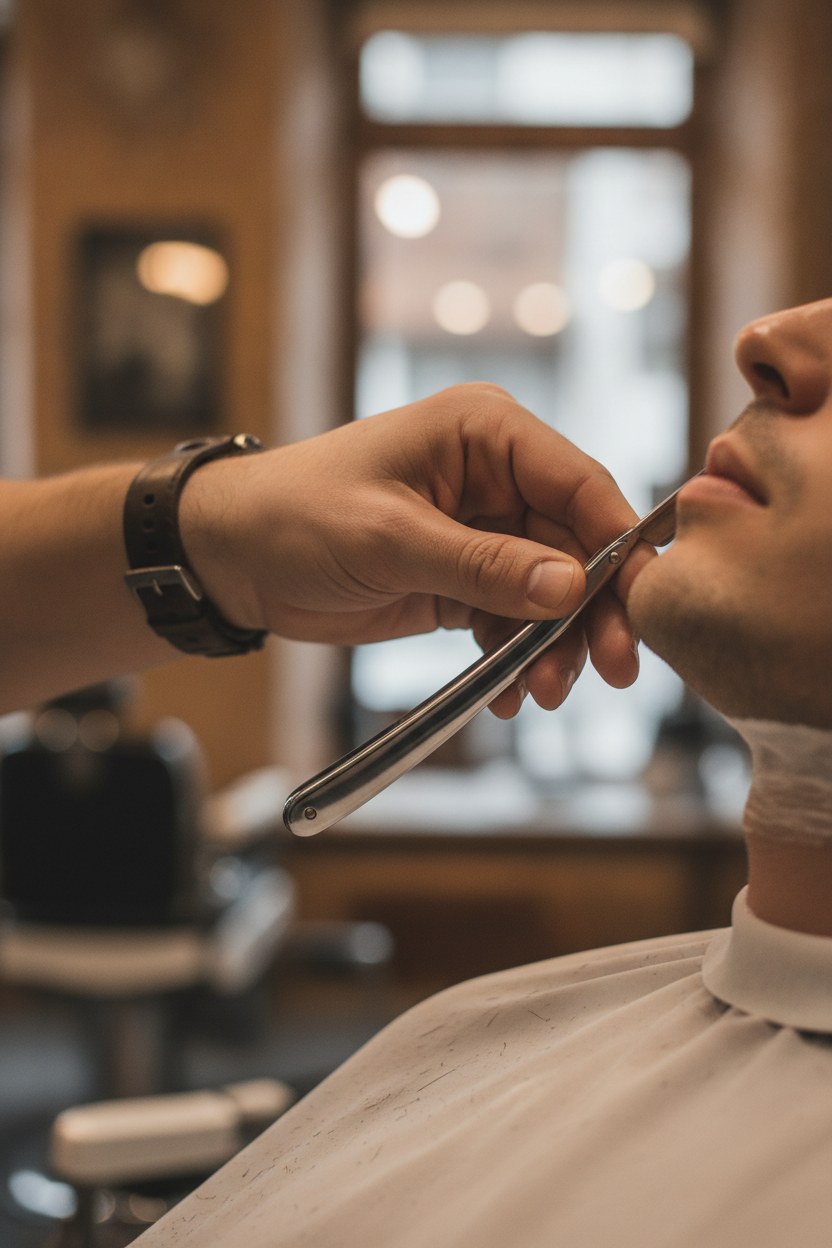
A cheek line is a decision — you can carry it a little higher or lower and it holds, because cheek hair is sparse and falls cleanly. A neck line is not a decision. It sits roughly two fingers above the Adam's apple, along the natural top of the growth, and if you shave above it you are fighting hair that will win.
| What you see | What it means | What to do |
|---|---|---|
| Hair resists a dry hand | You're going against the grain | Turn the stroke; that way is for a second pass only |
| Redness along the neck a day later | You shaved too close, likely against the grain | Neck gets one pass, with the grain, full stop |
| A straight, high cheek line | Shaved to a drawn line, not the growth | Let it grow a week; follow the real edge |
| Ingrown bumps below the jaw | Curled hair trapped under skin | Stop chasing closeness here — ask a doctor |
Towel, rest, towel — what the minutes buy you
Nothing here is wasted time. Each interval is softening or settling the skin so the next pass costs it less.
- min 0–3First hot towel. The beard swells and lifts. Coarse grain — anything reading as up or swirl — earns an extra minute here.
- min 3–5Lather, first pass. With the grain, every zone, light. The length comes off without the skin noticing.
- min 5–7Rest towel. Re-warm. Skin that just took a pass gets a moment before another. Re-lather only where you'll return.
- min 7–9Second pass, across the grain. Cheeks and chin only. This is the closeness pass, and it is optional every single time.
- min 9–10Cold finish. A cold towel closes everything down; a plain balm, no alcohol, and it's done.
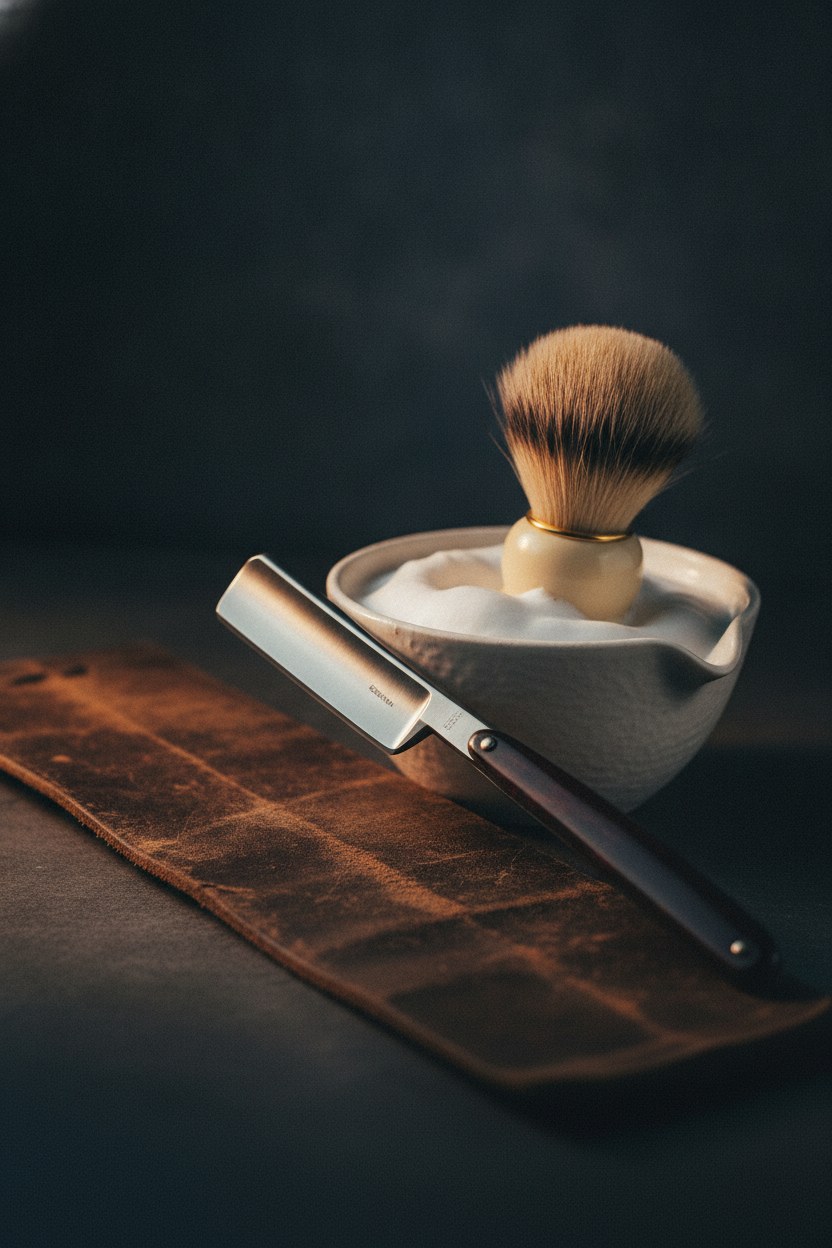
The strop realigns the edge between passes; the stone only comes out when the strop stops answering. A dull blade is what drags skin — not a sharp one.
Guards, millimetres and the grow-out clock
Length on this site is always a number of millimetres. A clipper guard is only a comb that holds the blade a fixed distance off the skin — so the number always travels with the millimetres it leaves.
Each number adds roughly 3 mm. Read the scale the way a barber calls it out — the highlighted step is a common cheek-to-fade setting.
- 0
- 0.5
- 1
- 2
- 3
- 4
| Guard | Leaves about | Reads as |
|---|---|---|
| #0.5 | 1.5 mm | skin's shadow, the bottom of a fade |
| #1 | 3 mm | tight, still shows the scalp |
| #2 | 6 mm | the safe everyday back-and-sides |
| #3 | 9 mm | length you can still comb |
| #4 | 12 mm | scissor-over-comb territory |
Hair grows about 1 cm a month — near enough 2.5 mm a week. A skin fade is a fortnight's shape at most; this is the week it starts to blur.
- W1
- W2
- W3
- W4
- W5
- W6
skin fade holds about three weeks
length steps on the bench, from bare skin to a comb's reach — and not one of them is a promise about your own hair.
How a careful sit actually runs
Read top to bottom, each step stepping a little further in — the way a grade is taken off, one guard at a time.
- 01
The dry read
Before water, a dry hand across the face in four directions. Feel where the grain resists and mark the neck line. One or two minutes.
- 02
First hot towel
The towel goes on and the chair reclines. The beard softens for two to three minutes while nothing else happens.
- 03
Lather & first pass
Brush-built lather, then one pass with the grain across every zone. Light pressure; the edge carries the weight.
- 04
Rest towel
A second warm towel settles the skin. Now you decide whether a closeness pass is a good idea today.
- 05
Second pass, if any
Across the grain on cheeks and chin only. The neck keeps its single pass. Never against the grain on the throat.
- 06
Cold finish
Cold towel, alcohol-free balm, and a look in the mirror so you know how it should feel at home.
What came back in the post
Notes from readers who tried the method at their own sink after the essay. Printed with permission; first name and district only.
I'd shaved my neck upward for fifteen years and wondered why it always burned. The essay said turn the hand against the grain first, feel it, then shave the other way in one pass. First morning in years it didn't sting.
I stopped drawing a high cheek line after reading this. Let it grow a week, followed the real edge like it said, and the shape finally looks even in photographs. Took me two tries to trust it.
The grain map was the part I didn't expect — drawing on paper which way everything grew made the whole thing obvious. Closest shave I've managed at home, and no bumps the next day.
Questions, answered plainly
How do I find my own grain at home?
Leave two or three days of growth. Run a dry hand across each zone in several directions. Where the stubble feels rough, you're going against the grain; where it feels smooth, you're going with it. Map each zone before you ever reach for water — that map is what the tool above builds into a plan.
Is against the grain always worse?
No — it's closer, which is exactly why people want it. It's also riskier, because the edge lifts the hair before it cuts and can leave it to curl back into the skin. Across the grain on the cheeks is a sane middle ground. Straight against the grain on the neck is where most irritation starts.
What do clipper-guard numbers mean in millimetres?
A guard is a comb that holds the blade a fixed distance off the skin. A #1 leaves roughly 3 mm, a #2 about 6 mm, a #3 about 9 mm — each number adds about 3 mm. We always name the millimetres beside the number, because the same guard cuts differently depending on how the clipper is held.
My neck always breaks out after a shave. Why?
Usually one of two things: shaving against a swirling neck grain, or chasing a line above where the hair actually stops. Both ask the skin for more than it can give. Switch the neck to a single pass with the grain. If bumps and redness persist, that's a dermatologist's question, not a barber's.
Can I book or buy anything here?
No. This is a reference journal, not a barbershop — there is no online booking, no checkout, and no account, by choice. You can write to the desk with a question or a reader letter, and that is all the site asks of you.
Hair loss, broken skin or lasting irritation is a doctor's question, not a blade's. This journal describes technique and length — it does not diagnose or treat anything.
Map your grain, then read the rest slowly
There is nothing to buy and nothing to book. Map the grain above, follow the order of operations, and write to the desk if the method raised a question.
no booking · no checkout · no account